
On the worktable
October 2026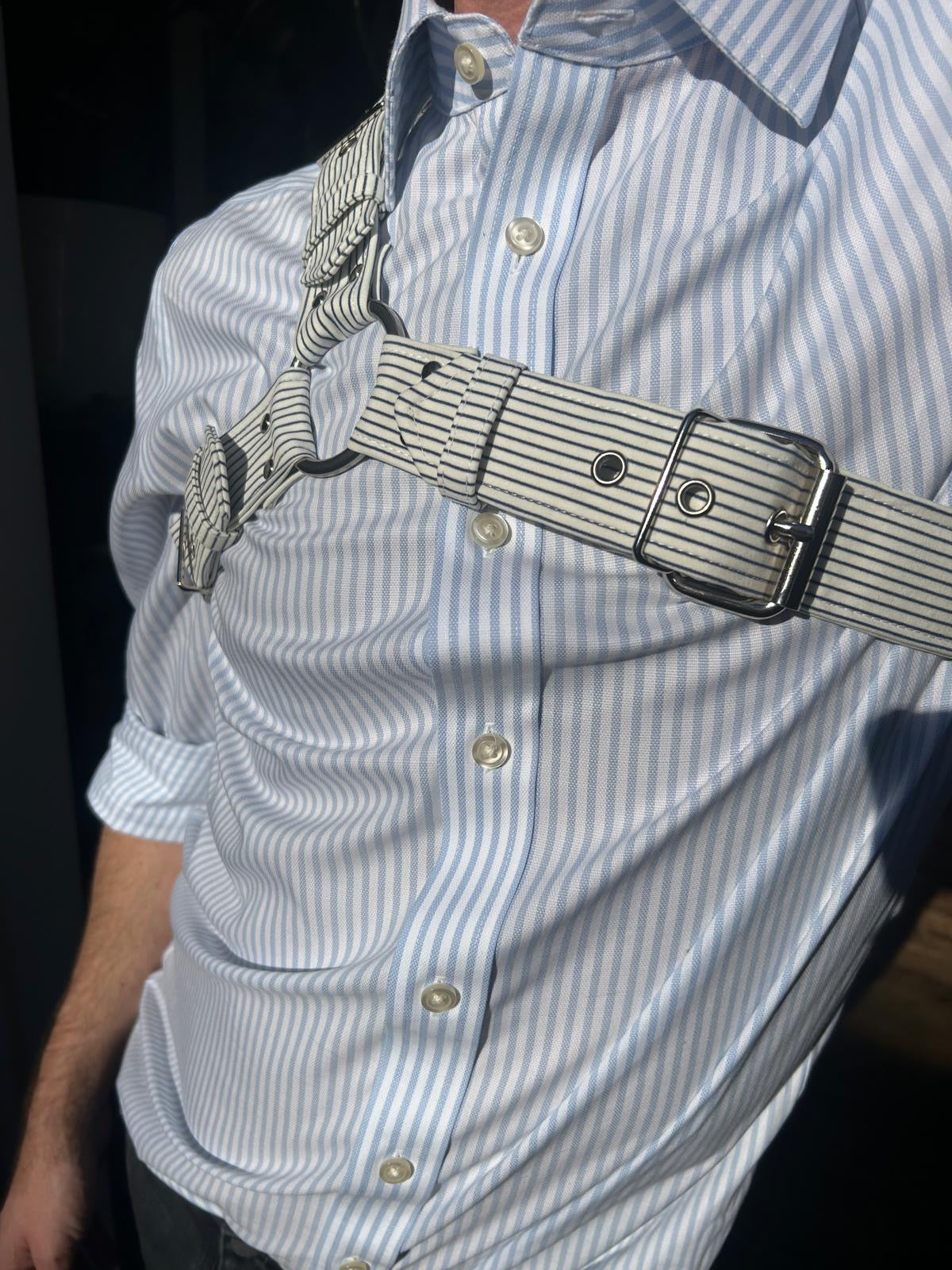
Every harness starts as a strip of cloth six inches wide.
It is folded and ironed down to a 1.5-inch strap: four layers at the finished width, the cloth's face showing on both sides, no raw edges. Inside the fold runs a 3-inch strip of heavyweight fusible interfacing, the strap's structural core. It is what lets a Morris print or a deadstock tie silk hold a buckle at belt-grade tension without softening or bowing over time.

Counting the parts
A Y Harness is nine strap components and 300.5cm of finished strap. An H Harness is fourteen components and 384cm. An X Harness is fourteen components and 424cm, the most cloth of the three. Every piece is sewn on a Singer Heavy Duty 4423, a domestic machine chosen deliberately over an industrial one.
The hardware
Rings, D-rings and buckles are nickel-plated and silver toned, made by F Martin & Son of Walsall, a family firm since 1870 in the old heart of the British buckle trade.
The joins are held with 8mm rivets and the adjustment holes are 6mm eyelets, both from Trimming Shop, set on the press they supply too. An H takes 16 rivets and 16 eyelets, an X takes 24 and 16, a Y takes 18 and 12. The rivets are there because of the very first harness, which used poppers. They gave way under movement, so the archive is riveted throughout.
The thread comes from G and A Haberdashery at Queens Market in Newham.
Made to fit one body
Every strap carries its own adjuster: three on the Y, four on the H, six on the X. Each piece fits a 34 to 50 inch chest, and the wearer dials it in once so it sits the way it should.
Cut, folded, riveted and finished in East London. Once.